

Here, we aim to understand intuitively the complex concepts of the DC/DC PWM control and PFM control operations by comparing the operations of electronic circuits with water.
1.Water tank (pool) and bucket model
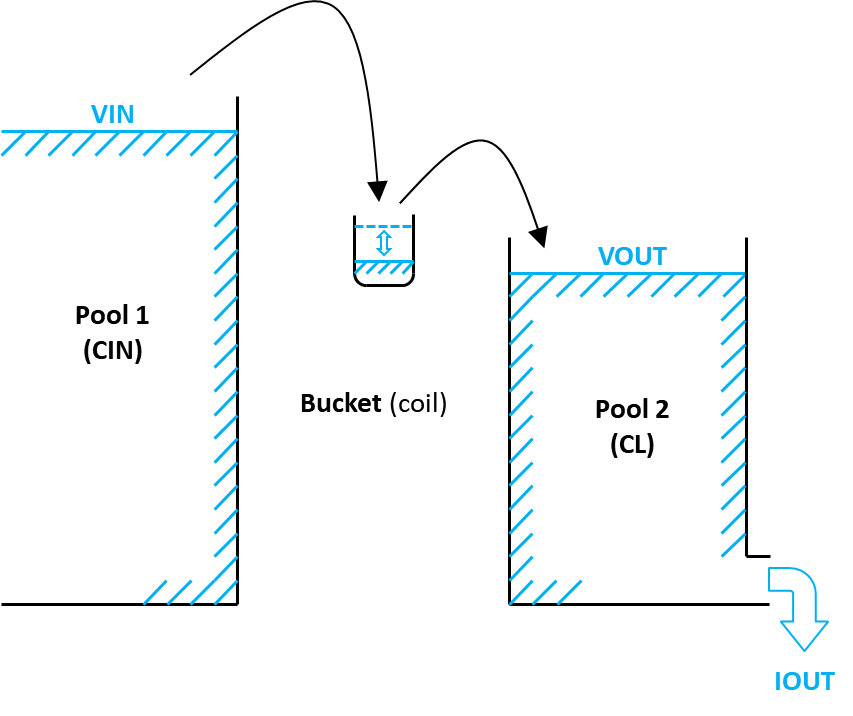
In this model, the DC/DC operation is represented by water being carried from pool 1 to pool 2 using a bucket. Even if the quantity of water supplied to outside (the output current) fluctuates, the water level in pool 2 (the output voltage) is always kept fixed.
- Large water tank (pool 1)
This represents the input capacitor (CIN) and the water level represents the input voltage. - Small water tank (pool 2)
This represents the output capacitor (CL) and the water level represents the output voltage.
The water flowing from this water tank corresponds to the output current used by a later stage device. - Bucket
This represents the coil (inductance). It carries the water from pool 1 to pool 2.
This bucket carries the water stably by alternately performing the operation to draw up the water (energy accumulating in the coil) and the operation to release the water (energy being released from the coil).
2.PWM control (Pulse Width Modulation)
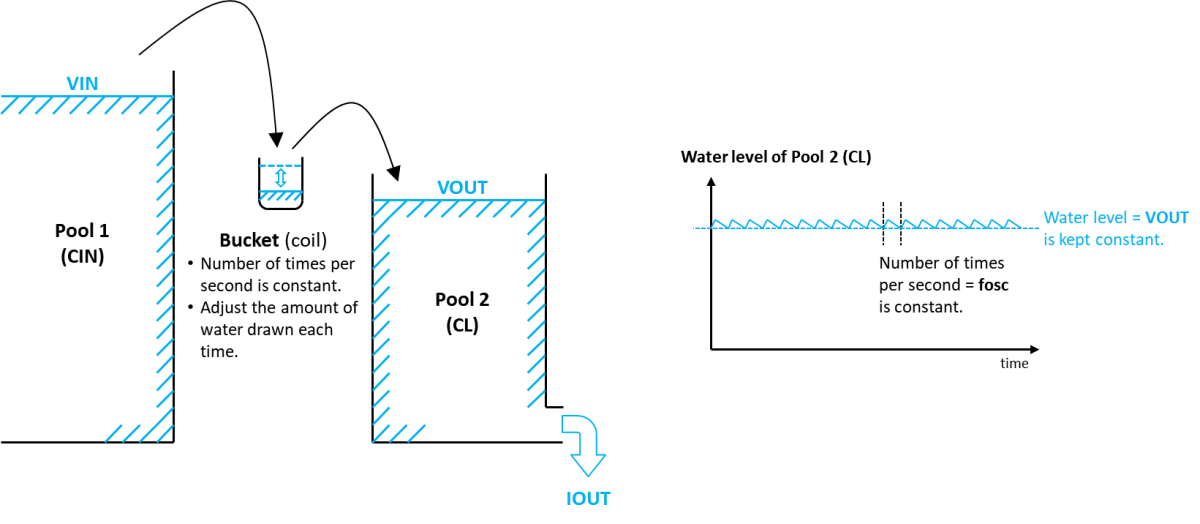
The PWM control is a method to keep the water level fixed by adjusting the amount of water put into the bucket in a fixed period.
Operation principles
1. Fixed interval (fixed frequency)
The operation to draw the water into the bucket is always repeated with a fixed interval (frequency).
This frequency is determined based on the DC/DC design.
2. Adjusting the water quantity (adjusting the pulse width)
To fix the water level of pool 2, it is necessary to supply to the bucket the same quantity of water as the quantity of water that flows out of pool 2 (output current).
In other words, when the quantity of water that flows out (output current) is large, the quantity of water drawn into the bucket (pulse width) is adjusted to be large, so that the water level (output voltage) is fixed.
- Characteristics of the PWM control method
The PWM control supplies water in a fixed period.
It is just like the image of a meticulous supervisor who always keeps watch over the water level, and if the water level drops even a little, immediately replenishes the water.
Through this operation, the fluctuations in the water level (the ripple voltage of the output voltage) are small with the PWM control, so it is employed widely where output stability is important, in analog circuits that are sensitive to noise and in high precision digital circuits.
Issues
- Drop in efficiency during a light load
The PWM control continues to move the bucket at a fixed interval, even if the output current is small.
Because the control continues to move the bucket at a fixed interval, the power to move the bucket (the supply current required for turning the switching element on and off) is required.
There is a drawback in the situation where the output current is small, in that the proportion of the supply power required for this operation is relatively large, and so the efficiency drops.
3.PFM control (Pulse Frequency Modulation)
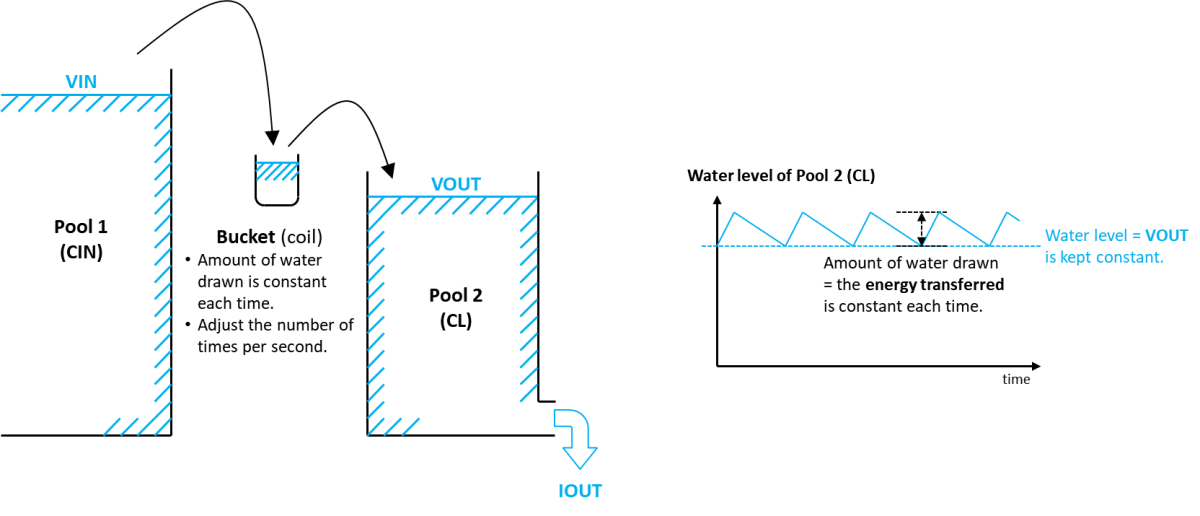
TThe PFM control is a method devised to solve the issue of the efficiency of the PWM control dropping during a light load, and emphasizes higher efficiency.
Operation principles
1. Adjusting the water quantity (fixing the pulse width)
The quantity of water put into the bucket is always fixed.
2. Adjusting the drawing-in interval (adjusting the frequency)
In the PFM control, the interval between water replenishments (frequency) is adjusted in response to the quantity of water (output current) that flows out of pool 2.
When the output current is large, water is successively carried in short intervals (the frequency is high), and when the output current is small, the water is carried slowly in longer intervals (the frequency is low).
The water level (output voltage) is fixed by adjusting the bucket filling interval in response to the output current.
- Characteristics of the PFM control method
This concept of moving only when required significantly reduces the wasteful power consumption during a light load, which was the disadvantage of the PWM control.
Issues
- The ripple voltage is large
In the PFM control, the quantity of water carried each time is large because the water filling interval is short.
In other words, because the output water level fluctuations (the ripple voltage of the output voltage) are large, caution is required when using applications or load devices that are sensitive to the ripple voltage. - Instability of the switching frequency
In the PFM control, the frequency fluctuates due to the output current.
The frequency fluctuating means that the frequency of the noise generated in the DC/DC also fluctuates.
Due to the frequency fluctuations, the design of the noise countermeasures (EMI countermeasures) is complex, and they may cause radio interference in other electronic devices, deterioration of sound quality in audio devices, or harsh noises.
Joined Torex Semiconductor in 2005.
After six years engaged in the development of power ICs such as DC/DC converters, worked for three years providing technical support for offline LED drivers.
Later took charge of technical support for Torex’s power IC customers.
With expertise gained through product development and extensive know-how accumulated from years of customer support — including solutions for power-related issues and troubleshooting — currently engaged in providing technical support and product proposals for Torex products.