

What are the differences between the current limit PFM and the COT control? Determining the one-time switching energy
In the switched-mode power supply control method, the PWM control and PFM control are widely used. The PFM control achieves high efficiency by fluctuating the switching frequency in response to the load current.
This explanation is effective for understanding the outline of the PFM control's operation, but it does not mention how to determine the quantity of energy to be supplied each time switching occurs.
Here, we describe the difference between the current PFM control and COT control to explain how to determine the quantity of energy required each time switching occurs in the PFM control.

1. Coil energy quantity
The DC/DC energy is supplied via the inductor.
Firstly, let's consider the quantity of energy accumulated in the coil.
The energy in the case that a current of Ipeak flowed to an inductor of the inductance value (L) is expressed by the following formula.
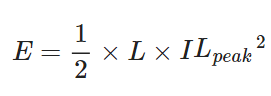
From this formula, we can see that the energy accumulated in the coil is large when the inductance value (L) is large and the coil current (Ipeak) is large.

2. Basic operation of the PFM control
In general, the PFM control controls the on duration and the coil current when switching using one of the following methods.
- Current limit PFM control: fixes the peak current flowing to the inductor, and fluctuates the switching frequency.
- Constant on time control (COT control): fixes the time for which the switching element is on, and fluctuates the switching frequency.
2-1.Current limit PFM control
As the name implies, the current limit PFM control fixes the peak current (Ipeak) flowing to the inductor.

Current limit PFM control - operation
- When the output voltage drops, the switching element turns on.
- The inductor current begins to rise.
- When the peak current threshold (IPFM) set by the inductor current is reached, the switching element is turned off.
- After the switching has halted, when the output voltage drops, switching is carried out again.
- 1 to 4 are repeated.
The current limit PFM control performs the control indicated above, and keeps the coil's peak current to the IPFM (the PFM control's control value).
At this time, the energy accumulated in the coil is

From this formula, we can see that the energy required for switching one time is large if the inductance value is large in the current limit PFM control.
In addition, if we make it so that the IPFM input voltage has no dependency on the input voltage or the output voltage, then a fixed switching energy is supplied regardless of the input voltage or the output voltage.
2-2. Constant on time control (COT control)
The constant on time control (COT control) controls the energy quantity supplied when switching one time, by keeping the switching on time (ton) fixed.

Constant on time control (COT control) - operation
- When the output voltage drops, the switching element turns on.
- The inductor current begins to rise.
- When the fixed time (ton) has passed, the switching element turns off.
- After the switching has halted, when the output voltage drops, switching is carried out again.
- 1 to 4 are repeated.
The constant on time control (COT control) performs control as indicated above, turning the switching element on for the on time (ton) of the fixed period.
In the on time (ton) of the fixed period, the increased amount (ΔIL) of the current in the case that the voltage (V) is applied to the coil is expressed as

and the voltage applied to the coil in the step-down DC/DC is (Vin - Vout), so we can write

Basically, at the point when the switching element in the PFM control begins to turn on, because the coil current is 0 mA,

Using the Ipeak found here, calculating the energy accumulated in the coil,

In contrast to the current limit PFM control, we can see from these results that when the inductance value is large, the amount of energy required for one time is reduced.
In addition, when the input voltage fluctuates, COT controls also exist in which the ton fluctuates due to the input voltage fluctuation, so that whether the energy for one time increases or decreases due to the input voltage increase depends on the COT control method (the way ton is determined).
3.Final remarks
We have explained how the switching energy amount for one time is determined, as an important step for understanding the detailed characteristics of the PFM control.
By applying this knowledge, you can calculate the switching period and ripple voltage, etc. in actual circuits.
Joined Torex Semiconductor in 2005.
After six years engaged in the development of power ICs such as DC/DC converters, worked for three years providing technical support for offline LED drivers.
Later took charge of technical support for Torex’s power IC customers.
With expertise gained through product development and extensive know-how accumulated from years of customer support — including solutions for power-related issues and troubleshooting — currently engaged in providing technical support and product proposals for Torex products.